TL;DR
In 2020, machine learning sat inside the interface as a feature: a recommendation carousel, a smarter search box, a chatbot in the corner. In 2026 it increasingly assembles the interface itself. Brands now use machine learning to improve UX through adaptive layouts that reorder based on intent, generative UI that composes screens at runtime, and prediction that removes steps before a user reaches them. Two forces make this urgent rather than experimental. Gartner expects 40 percent of enterprise applications to include task specific AI agents by the end of 2026, up from under 5 percent, which means a growing share of your traffic is not human. And the European Accessibility Act became enforceable in June 2025, which makes the semantic structure that agents rely on a legal requirement rather than a preference. The brands that benefit are the ones with a single, resolved view of the customer underneath all of it.
Key Takeaways
- Machine learning moved from a feature to the assembly layer. Brands now use machine learning to improve UX at the structural level rather than inside a fixed page. It decides what the page contains, in what order, and for whom.
- Adaptive is not the same as personalised. Personalization changes what a user sees. Adaptive interfaces change the structure of the path itself, which raises the stakes on predictability.
- Part of your user base is now software. AI agents navigate, fill forms, and transact on behalf of people, and they read your interface differently than a human does.
- Accessibility became the agent interface by accident. Agents often read the browser accessibility tree rather than the visual page, so semantic HTML now serves both disabled users and machine users.
- Generative UI is real but early. The W3C has formed a community group on interfaces synthesised at runtime, which signals a genuine shift and also that the standards are unsettled.
- The constraint is data, not models. Gartner predicts organizations will abandon 60 percent of AI projects not supported by AI ready data through 2026. A fragmented customer record caps how good any adaptive experience can get.
- Changing interfaces need governed change control. When the system composes the screen, testing a fixed design no longer proves anything. You test the rules and the boundaries instead.
Why This Article Needed Rewriting
The original version of this post was written when the state of the art was a recommendation engine on a product page and a model quietly ranking search results. The advice was to collect behavioural data, feed it into a model, and make the experience more relevant. That was correct, and it now describes roughly the first ten percent of what the discipline covers.
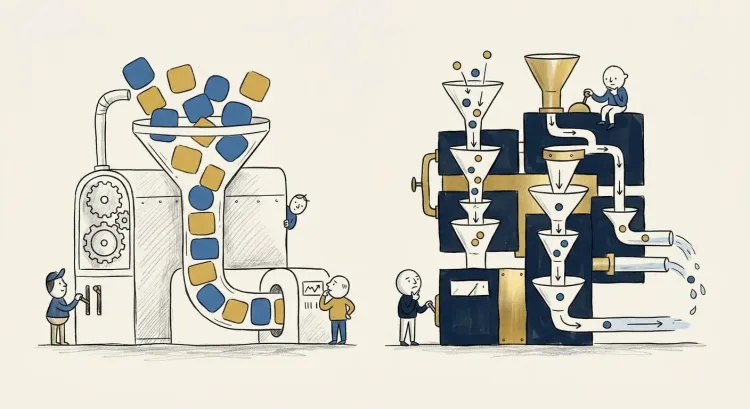
What changed is the scope of what the model touches. A 2020 recommendation engine chose the contents of a module inside a page a designer had drawn. A 2026 system decides which modules appear, in what order, which steps to skip, and in some products it composes the layout at request time from a catalogue of approved components. The designer still defines the vocabulary. The system increasingly writes the sentence.
A second change is stranger and gets less attention. A meaningful and growing share of the visitors to a brand experience are not people. They are agents acting for people, and they read a page through structure rather than through visual hierarchy. This article covers how brands use machine learning to improve UX under both of those conditions, what the evidence currently supports, and what has to be true in the underlying data before any of it works.
FAST FACT: Gartner expects 40 percent of enterprise applications to be integrated with task specific AI agents by the end of 2026, up from less than 5 percent in 2025, and forecasts that agentic AI could account for roughly 30 percent of enterprise application software revenue by 2035.
Source: Gartner, August 2025
How Have Brands Used Machine Learning to Improve UX Since 2020?
Four shifts explain most of the distance between the original article and this one.
- From ranking content to composing experience. Models used to sort items inside a container. They now select and sequence the containers, which moves the output from content decisions to structural ones.
- From batch to request time. Segments computed nightly became inferences made during the session, which means the experience can change while the user is inside it.
- From one interface to many. The same product is now consumed through a screen, a voice surface, a chat interface, and an agent. Each reads a different representation of the same underlying system.
- From tested to generated. When a design is composed at runtime, no single artifact exists to usability test. The unit of testing becomes the rule set and the component library rather than the screen.
UX quality has therefore become partly a data and systems question. A brilliant designer working on top of a fragmented customer record ships a beautifully considered experience that guesses wrong about who the user is, and the guess is what the user notices.
Where Does Machine Learning Actually Touch the User Experience?
Brands use machine learning to improve UX in five distinct places, and it is worth separating them, because they carry very different risk and very different payoff.
Prediction that removes work. Prefilled fields, anticipated next steps, smart defaults, and skipped onboarding for users the system already understands. This is the least visible application and often the highest value, because the best outcome is that the user never notices anything happened.
Ranking and retrieval. Search, recommendations, and content ordering. The mature category, well understood, and still where most measurable commercial lift comes from.
Adaptive structure. Interfaces that reorder navigation, promote or demote features, and change the length of a flow based on the user context. Higher payoff and considerably higher risk, because unpredictability erodes trust faster than irrelevance does.
Conversational and agentic surfaces. Assistants that operate the product on the user behalf. This is where design work shifts from arranging controls to showing intent, progress, evidence, and a reliable way to interrupt.
Support and service experience. Routing, triage, deflection, and proactive outreach before a customer complains. Because this layer draws on the same customer record as the rest of the business, service and customer work connected to the revenue model tends to outperform a support tool operating on its own data island.
FAST FACT: McKinsey found that 88 percent of organizations regularly use AI in at least one business function, but only around 6 percent attribute 5 percent or more of enterprise EBIT to it, with workflow redesign the change most strongly associated with real impact.
Source: McKinsey, The State of AI in 2025
How Do Brands Personalise an Interface Without Making It Unpredictable?
This is the central design tension of adaptive user interfaces, and it is not solved by better models. It is solved by rules about what may change.
People build spatial memory of software. They remember that the export button sits at the bottom of the left panel. An adaptive system that relocates it on predicted intent will be right often enough to demo well and wrong often enough to make an experienced user feel the product is unreliable. That feeling costs far more than the saved click is worth.
Four constraints keep adaptation useful:
- Keep primary navigation and destructive actions fixed. Adapt content, emphasis, and sequence, not the location of the controls people have memorised.
- Make the adaptation legible. If the interface reordered something, say so briefly. Unexplained change reads as instability rather than intelligence.
- Always provide the unadapted path. A visible way back to the standard view costs almost nothing and prevents the experience from feeling like a trap.
- Adapt on confident signals only. A low confidence inference should produce the default experience, not a guess.
Personalization at scale also depends on knowing the same person across sessions, devices, and channels, which is a data problem long before it is a design one. Campaign and journey work running through Lucrative Marketing on a shared customer record avoids the common failure where the website, the email, and the support desk each personalise around a different version of the same customer.
What Is Generative UI and Is It Ready for Production?
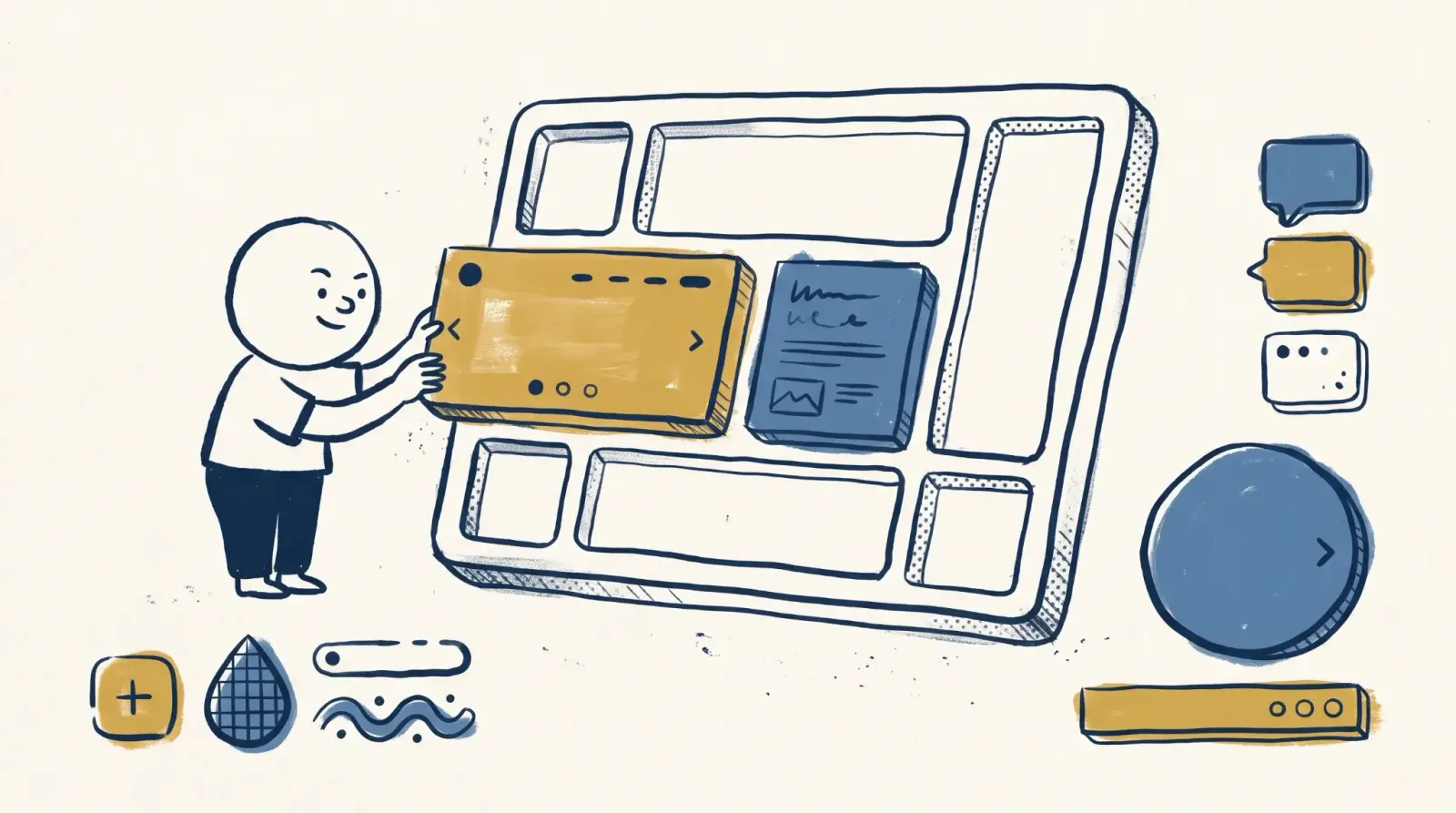
Generative UI describes interfaces synthesised at runtime from intent and context rather than authored in advance. Instead of a designer producing a screen and an engineer building it, the system assembles a screen from a catalogue of approved components in response to what the user is trying to do.
The signal that this is more than a trend cycle is institutional. The W3C has stood up a community group to examine how runtime generated interfaces interact with interoperability, performance, and accessibility on the web. Standards bodies do not convene around ideas going nowhere. They also do not convene around settled ones, which is the honest read on maturity.
The sensible position in 2026 is partial adoption. Generate within a constrained component library rather than freely, apply it to genuinely variable surfaces such as configuration, results, and summaries, and keep checkout, payment, and account changes as fixed, tested paths. Regulated and high consequence interfaces should stay authored. The efficiency gain is real, and it is not worth an unreviewable payment screen.
FAST FACT: The W3C has launched a Generative UI Community Group to examine interfaces synthesised at runtime from intent and context rather than pre authored, including the implications for interoperability, performance, and accessibility on the web.
Source: W3C Generative UI Community Group
Why Are AI Agents Now Part of Your User Base?
Because they are already navigating your product. Agents browse sites, compare options, complete forms, and transact on behalf of people, and Gartner expects task specific agents inside 40 percent of enterprise applications by the end of 2026. Whatever share of your traffic that represents today, the direction is not ambiguous.
What matters for design is how they read. Nielsen Norman Group research on AI agents as users finds that agents frequently work from the browser accessibility tree, the structured representation generated from your HTML, rather than from a screenshot of the rendered page. It is cheaper to process and more reliable, and it is the same structure a screen reader uses. The implication is unexpectedly convenient: an interface built properly for accessibility is already far more legible to an agent, while a visually beautiful one built from unlabelled divs is close to unreadable to both.
A third path bypasses the interface entirely. When a structured interface exists, an agent can query and act directly rather than simulating clicks, which is far more reliable than screen driving. Exposing that path deliberately, as MCP Access does for supported AI clients operating under defined rules, is becoming a design decision rather than purely an engineering one. The question is no longer whether machines will use your product. It is whether you give them a sanctioned route or leave them guessing at your buttons.
What Does Machine Learning Change About User Research and Testing?
It changes the unit of study. You cannot usability test a screen that does not exist until a user requests it.
- Test the rules, not the render. Define the conditions under which adaptation triggers and evaluate whether those conditions produce sensible results across representative user situations.
- Test the boundaries and the failures. The interesting cases are new users with no history, users whose behaviour contradicts their segment, and low confidence inferences. The average case rarely breaks.
- Use holdouts, not just variant tests. When a system optimises continuously, a classic two variant test measures a moving target. A held out group receiving the unadapted experience is the honest comparison.
- Watch abandonment shape, not just rate. Where people stop tells you more about a broken adaptation than how many did.
Generative research tooling is useful for synthesis, pattern finding, and drafting research plans. It is not a substitute for observing people, and simulated users are not evidence about real ones. Reconciling what interface analytics claim against what happened in the customer relationship belongs in revenue analytics that can trace a reported result back to the underlying records, because an experience metric that never connects to retention or revenue is a vanity number with good intentions.
Why Does Accessibility Suddenly Matter More Than It Did?
Three separate pressures converged on the same technical work, which almost never happens.
The first is legal. The European Accessibility Act came into force across the EU on 28 June 2025, applying to any provider offering ecommerce services to EU consumers regardless of where that provider is based, with obligations including a published accessibility statement and ongoing conformity. This is no longer a design preference. It is a compliance requirement with market surveillance attached.
The second is agentic, as covered above: the accessibility tree is the agent interface, so semantic structure now determines whether a machine user can complete a purchase on your behalf.
The third is that models trained on your interface data inherit its gaps. If a flow is unusable with a keyboard, the data from that flow underrepresents the people who could not complete it, and the model optimises against a population that was already filtered. For brands operating in retail and ecommerce the three pressures land on the same backlog, which is unusually good news: one body of work satisfies a regulator, a machine user, and a model at once.
What Data Does Any of This Actually Require?
Less exotic than teams expect, and better resolved than most teams have. Useful customer experience data comes down to four things, in order of how often they are the blocker.
- A resolved identity. One customer, one record, consistent across web, app, CRM, billing, and support. Without this, every downstream personalisation is a guess about which fragment is the real person.
- Behavioural history with context. Not just events, but what the user was trying to accomplish. A page view without an inferred intent is a weak feature.
- Outcome data. What happened after the session. An interface optimised toward engagement without knowing whether the customer stayed will efficiently produce engaged customers who churn.
- Consent state. What this user has permitted, per jurisdiction, in a form the runtime can actually read at decision time rather than in a policy document.
The first is where most programmes stop. Revenue data consolidation and a maintained connection across the surrounding systems through Integration Cloud are the prerequisites that decide the ceiling on experience quality, and they are the least interesting slide in any deck about design. Connecting the experience signal to customer health and renewal is what closes the loop between what someone did in the product and whether they remained a customer.
SUMMARY
Brands use machine learning to improve UX very differently than they did in 2020. The model no longer fills a module inside a page a designer drew. It selects the modules, sequences the steps, removes work the user would otherwise do, and in some products composes the layout at runtime from approved components. Adaptive interfaces earn their keep when they change content, emphasis, and sequence while leaving navigation and destructive actions exactly where people remember them. Generative UI is real enough that the W3C has convened a community group on it, and unsettled enough that checkout and regulated flows should stay authored and tested.
The two developments most likely to be underestimated are that a growing share of users are AI agents reading the accessibility tree rather than the visual page, and that the European Accessibility Act made the semantic structure those agents depend on legally enforceable in June 2025. Both point at the same backlog as good accessibility practice, which is a rare alignment of regulator, machine user, and model. Underneath all of it, the binding constraint is a resolved customer identity with behavioural history, outcome data, and readable consent state attached. Get that right and the design work compounds. Skip it and every adaptive experience is a confident guess about a person the system does not actually know.
Ready to Fix What Sits Underneath the Experience?
Every adaptive interface is only as good as its answer to one question: who is this person, and what has already happened between them and us. If that answer is spread across five systems, no amount of design work makes the experience feel intelligent. Defining the customer model once through Revenue Blueprint and running the work on top of it inside an AI native revenue engine is what gives the experience layer something reliable to reason from. Talk to the Lucrative team about connecting the customer record behind your product experience.
How Do You Govern an Interface That Changes Itself?
The moment a system composes the experience, the old release process stops providing assurance. A design review proves nothing about a screen that will be assembled differently tomorrow.
Five controls replace it:
- A constrained component library. The system may only assemble from reviewed, accessible, brand compliant pieces. Design system governance is the single most effective control available here.
- Declared no change zones. Checkout, consent, account deletion, pricing, and legal text are fixed by policy and excluded from adaptation.
- Logged decisions. A record of what the system showed a given user and why, because you cannot debug or defend an experience you cannot reconstruct.
- A drift review cadence. A scheduled check on what the system is actually producing, since adaptive systems degrade quietly rather than failing loudly.
- A named owner and a stop control. Somebody accountable for the experience the system generates, with the authority and the mechanism to revert to the fixed version.
This is the same discipline that the Governance Control Plane applies to automated action elsewhere in the revenue stack, and the reasoning transfers directly: define the boundary, the evidence, and the owner before the system acts, not after an incident. Running adaptive work through AI Native Mode, where a plan is proposed and a person approves it, is the same pattern applied to the experience layer.
Frequently Asked Questions
How do brands use machine learning to improve UX in practice?
The most common applications are ranking and recommendation, predictive assistance that removes steps such as prefilled fields and skipped onboarding, adaptive structure that reorders content by inferred intent, conversational surfaces that operate the product on the user behalf, and support experiences that resolve issues before the customer has to ask. The highest value work is usually the least visible. Removing three steps from a flow produces more measurable benefit than a recommendation carousel and carries far less risk of confusing anyone.
What is the difference between personalization and an adaptive user interface?
Personalization changes the content a user sees inside a structure that stays the same. An adaptive interface changes the structure itself, reordering steps, promoting or hiding features, and altering the length of a flow. The distinction matters because the failure modes differ. Bad personalization is irrelevant, which is mildly annoying. Bad adaptation is unpredictable, which undermines a user confidence in the whole product and is much harder to recover from.
Is generative UI ready to use in production?
Partially, and the sensible approach is selective. Generating within a constrained library of approved components on variable surfaces such as results, summaries, and configuration is defensible today. Generating core transactional flows, payment steps, or regulated interfaces is not, because you lose the ability to test and defend exactly what a user was shown. The W3C has formed a community group on runtime generated interfaces, which tells you both that the shift is real and that the standards are still being worked out.
Do we need to design for AI agents as well as people?
Increasingly, yes, and the good news is that most of the work overlaps with accessibility. Agents commonly read the browser accessibility tree rather than the rendered page, which is the same structure screen readers use, so semantic HTML, properly labelled controls, clear roles, and logical hierarchy serve both audiences at once. Where you want agents to transact reliably, a structured interface they can call directly is far more dependable than expecting them to drive your buttons.
How do you A/B test an interface that changes for every user?
You shift the unit of testing from the design to the rules. Define the conditions that trigger adaptation, evaluate whether they produce sensible outcomes across representative situations including edge cases, and maintain a holdout group receiving the unadapted experience as your baseline. A conventional two variant test is unreliable against a continuously optimising system because the variant itself keeps moving while you measure it.
What is the most common reason machine learning UX projects fail?
Fragmented customer identity. When the same person exists as different records across web analytics, the CRM, billing, and support, the system cannot reliably know who it is adapting for, so it personalises around a partial view and gets it visibly wrong. Gartner predicts organizations will abandon 60 percent of AI projects not supported by AI ready data through 2026, and experience projects are not exempt. The fix is upstream in data resolution, not in the design tooling.
Does accessibility work actually help machine learning UX?
Directly, in two ways. Semantic structure is what agent users read, so accessible markup is functionally the agent interface. And behavioural data collected from an inaccessible flow systematically underrepresents the people who could not complete it, which means any model trained on that data optimises against a pre filtered population. Since the European Accessibility Act became enforceable in June 2025, the same work also satisfies a legal obligation for anyone selling to EU consumers.